Article takeaways
- Atlanta is one of the fastest-growing cities in the U.S., with a diverse economy anchored by Fortune 500 headquarters, a booming film industry, and a thriving tech sector.
- The cost of living is higher than the national average but significantly more affordable than comparable major metros like New York, Miami, and Los Angeles.
- Atlanta’s neighborhoods range from upscale and corporate (Buckhead) to historic and eclectic (Inman Park, Old Fourth Ward), offering something for virtually every lifestyle.
- While MARTA provides subway and bus service, Atlanta is primarily a car-dependent city with notoriously heavy traffic.
- The city is rich in Civil Rights history and cultural offerings, from world-class museums and festivals to street art and a thriving restaurant scene.
Folks looking to relocate to metro Atlanta are not alone. The capital of Georgia has seen steady growth over the last couple of decades.
The influx of entertainment and tech opportunities has had a booming impact on the job market. The increase in career and creative opportunities has spurred the relocation even more so in the past few years.
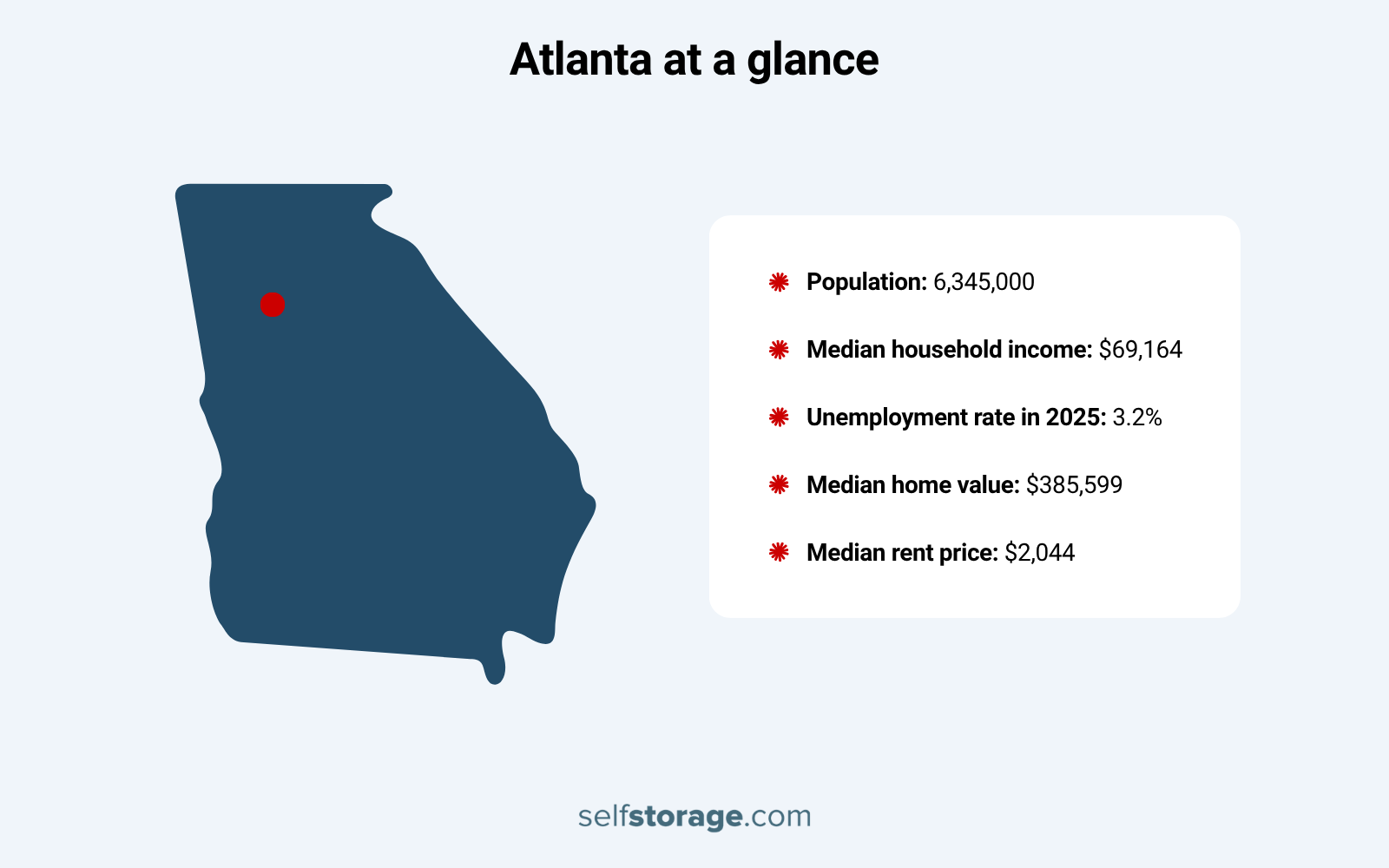
In 2022, the population crossed the 6 million mark and is still growing. Given the interest in this southern gem, it’s no surprise that Atlanta ranks second among cities people would choose to move to if money were no object.
The Big A (or the Big Peach, or the Big ATL) is an urban sprawl, resting in both DeKalb and Fulton County. ATLiens love their diverse, multicultural city full of history, eclectic neighborhoods, hip eateries, and a more affordable housing market than similar metro areas.
This helpful guide will break down all the reasons to move to Atlanta and what to expect when you get there. We’ll also cover the process of moving there and how SelfStorage.com can help you get there.
A City Steeped in History and Culture
Atlanta’s history is deeply rooted in the Civil War and the modern Civil Rights Movement. This history is felt throughout the city, from the Martin Luther King, Jr. National Historic Park, to the Atlanta from the Ashes statue of a woman holding a phoenix.
The symbol of Atlanta, the phoenix, is a reminder of a city that has literally risen from the ashes after it was burned down in the Civil War.
Today, Atlanta is a diverse city dedicated to cultural growth. Not only will you find award-winning theater and a Grammy-winning orchestra, but you will also have access to a variety of museums and other cultural hot spots.
The High Museum of Art is the leading art museum in the region and features exhibits from around the world.
Engaging interactive art and history can be explored at the Atlanta History Center, the Center for Civil and Human Rights, and the Fernbank Museum of Natural History.
Those who prefer authentic street art may want to venture toward Little Five Points, Krog Street Tunnel, and the BeltLine for colorful murals and graffiti art.
The city also hosts several big festivals and events, including the Atlanta Film Festival, the Atlanta Jazz Festival, the Atlanta Pride Festival, the second-largest Pride parade in the U.S., and the National Black Arts Festival.
Eclectic Job Opportunities and a Low, Steady Unemployment Rate
Georgia started 2023 with all-time high job numbers and an unemployment rate lower than the national average. Atlanta has kept in line with its state, with an unemployment rate just a bit higher at 3.2 percent. It’s no surprise: Atlanta’s economy is the 10th largest in the country.
Atlanta, Georgia, is also a top U.S. city when it comes to Fortune 500 company headquarters. Atlanta is home to Delta Air Lines, Equifax, Coca-Cola Company, The Home Depot, UPS, Waffle House, and Newell Rubbermaid. And that means lots of jobs
Atlanta has been nicknamed the “Hollywood of the South” thanks to its booming film industry. And this boom obviously comes with an uptick in the film industry.
Atlanta is also noted to be the region’s Silicon Valley, since its a technology hub. The Southern tech town offers a slew of big tech-related job opportunities.
Outside of the technology hub and film industry, Atlanta’s health care industry is expanding. Atlanta is home to such large-scale employers as Emory Healthcare and The Children’s HealthCare of Atlanta children’s hospital.
It takes a lot of energy to power such a happening city, and utility companies like Georgia Power and Atlanta Gas Light offer lots of trade jobs. Othe fast-growing industries include business, finance, and construction.
Atlanta Offers a Relatively Lower Cost of Living for a Big City
Although Atlanta, as a major metropolitan area, comes at a higher cost of living than the national average, it’s still more affordable than major cities like New York, Philadelphia, Miami, and Los Angeles.
The median household income was $69,164 as of the 2021 Census, just slightly under the national median for the same year.
A large factor in the higher cost of living is the city’s housing market. Atlanta saw a rise in housing costs over the last couple of years, with a slight drop in 2023.
The median home sale price of $390,000 was 2.4 percent lower in March 2023 than it was a year prior. Homes are still receiving multiple offers, keeping the market somewhat competitive, but more attainable than it had been.
As of May 2023, renters are finding median rent prices of $1,518 for a one-bedroom apartment and $1,522 for a two-bedroom.
Your Choice of Culture, Entertainment, and Upscale Experience
Whether you’re looking for quality restaurants within walking distance, a buzzing social scene inside the urban sprawl, or peace and quiet for the family, Atlanta’s neighborhoods have something for everyone.
Here are some of the more highly recommended neighborhood profiles:
BUCKHEAD
One of the more popular neighborhoods in the Atlanta metropolitan area, Buckhead features high-rises and new condo buildings among old and new townhouses. Corporate professionals looking for upscale living will enjoy the great dining and shopping a quick walk from the office.
INMAN PARK
Take the upscale vibes of Buckhead and add in some quirk and you have Inman Park. This walkable, trendy neighborhood has some great pubs and bars, record stores, vintage shops, and sits on the Beltline, granting easy access to other great neighborhoods.
MIDTOWN
The revitalized Midtown neighborhood is one of the city of Atlanta’s cultural epicenters. You’ll have plenty of museums and galleries to explore during the day, and restaurants and entertainment to fill your nightlife.
OLD FOURTH WARD
This neighborhood is one of the best places to live in Atlanta. It is deeply rooted in the history of the Civil Rights era and is the birthplace of Martin Luther King, Jr. Today, it attracts foodies who love its trendy dining, big shoppers, and craft beer lovers.
DECATUR
Decatur is actually its own city, but it’s great for those looking to be near Downtown Atlanta without dealing with the same level of traffic. Residents enjoy festivals, independent shops, small businesses, and an overall close community.
Other neighborhoods to include in your Atlanta home search:
- Peachtree Heights
- Sandy Springs
- Cabbagetown
- Grant Park
- Virginia-Highland
Plenty of Traffic and Limited Public Transportation
Atlanta Rapid Transit Authority (MARTA), our subway/elevated train system, is clean and safe and fairly cheap to ride.
Atlanta is a car-oriented city, and for good reason. Although public transportation is available through the Metropolitan Atlanta Rapid Transit Authority (MARTA), its bus and train lines are limited when compared to similar metro areas.
Although expansions and improvements have been made with more promise, residents are advised to have alternative options available if they need to get somewhere off-route.
The resulting traffic has led the city, along with organizations like Atlanta Bicycle Coalition, to increase its walking and biking trails.
All that aside, if you’re looking to get out of the city, you have a major hub to fly from.
Despite the pandemic’s effect on traveling, Atlanta’s Hartsfield-Jackson International Airport has continued to be the world’s busiest airport by passenger volume, with nearly 100 million travelers making their way through its terminals in 2022!
Education Opportunities in Atlanta Are Improving
Georgia is behind the national average when it comes to per-student spending, has banned the teaching of divisive topics, and is experiencing a related teacher shortage. While it is not one of the lowest-ranked states for public education, it still has room to grow and improve.
But Atlanteans have risen to the occasion by investing in a variety of alternatives. Parents seeking an alternative to the Atlanta public schools classroom will have 143 private and charter schools to choose from.
Those looking for great colleges and universities will appreciate checking out Emory University, Georgia Institute of Technology (aka Georgia Tech), Georgia State, and Spelman College, just to name a few. Morehouse College, one of the top HBCUs in the country, also makes its home in Atlanta.
Nature Surrounds Atlanta, Georgia
Despite being a major urban center, Atlanta is remarkably close to some of the Southeast’s most breathtaking natural landscapes.
To the north, the Appalachian Mountains offer world-class hiking, camping, and scenic drives, with trailheads accessible within just a couple of hours from the city.
Closer in, the North Georgia mountains provide weekend escape opportunities for outdoor enthusiasts, from waterfall hikes to white-water rafting.
Lake Lanier, a sprawling reservoir about an hour north of downtown, is a beloved local destination for boating, fishing, swimming, and lakeside recreation throughout the warmer months.
Within the city itself, the Chattahoochee River serves as a natural recreational corridor, offering kayaking, tubing, and riverside trails through the Chattahoochee River National Recreation Area.
Stone Mountain Park, just east of the city, draws visitors for hiking, scenic views, and family-friendly outdoor activities centered around its iconic granite monadnock.
Atlanta also takes its environmental stewardship seriously. The city’s Department of Watershed Management oversees efforts to protect local waterways and ensure clean water access for residents.
These initiatives are complemented by broader water conservation programs designed to sustainably manage the region’s resources as the population continues to grow.
Summers are Humid in Hot ‘Lanta
Did you catch that nickname? Like the rest of the U.S. southern region, Atlanta is known for hot and humid summers. It also tends to experience its fair share of rain and thunderstorms, but otherwise, this four-season city experiences mild weather.
Atlanta tends to be coldest in January, with average low temperatures of 33 degrees Fahrenheit. July balances that with temperatures hitting and sometimes exceeding 89 degrees.
10 Can’t-Miss Things to Do in Atlanta
The City of Atlanta is a dream for sightseers and history buffs, and there’s also plenty of shopping, great food, and more to be found. Here’s a list of 10 must-dos in the Big Peach:
- Experience Civil Rights Movement history with a visit to the Martin Luther King, Jr. National Historic Park, made up of about 35 acres of historic sites, including the birth home of MLK Jr. and the King Center.
- Meet the Coca-Cola Polar Bear and have a refreshing drink at the World of Coke, a museum dedicated to the history of the famous soda company.
- Enjoy outdoor gardens, the Storza Woods Canopy Walk, and more at the Atlanta Botanical Garden—considered an urban oasis and one of the best places in the city!
- Get outdoors at Piedmont Park, perfect for a stroll, a jog, a round of tennis, and more. The park hosts a variety of events, including a farmers’ market on Saturdays.
- Catch your favorite artist or watch the Atlanta Falcons and Atlanta United FC play at the world-class Mercedes-Benz Stadium.
- See a show or take a tour of the iconic Fox Theatre in Midtown, a former movie palace known for its ornate, Egyptian- and Spanish-inspired designs.
- Experience firsthand the comprehensive revitalization efforts being undertaken in the city with a walk through the Atlanta Beltline.
- Visit more than 100,000 animals from 500 species at the Georgia Aquarium, the largest aquarium in the U.S. and the third largest in the world.
- Check out the boutiques, dining, and rooftop park at Ponce City Market.
- Take the kids to jump in the Fountain of Rings at Centennial Olympic Park, a 22-acre park originally built for the 1996 Olympic Games.
Moving to Atlanta? Here’s how SelfStorage.com can Help You Settle In
By now, you should have a pretty good idea of all the reasons to move to Atlanta. We’ve covered work opportunities, neighborhoods to live in, cost of living, and things to do in your free time.
Now that you know why you want to move to Atlanta, let’s talk a little bit about how. For starters, you definitely don’t wait until moving day to pack. We suggest starting the packing phase with a decluttering process, evaluating which items you’re ready to donate or throw out.
Label boxes, wrap fragile items carefully, and create a home inventory list as you go for each room to stay organized.
Renting a self-storage unit is a great option for simplifying your moving day logistics, giving you time in between moves, or providing a little extra space at home. Storage fees for an entire month are often lower than the cost of a truck rental for a single extra day.
You can save money in the long run by packing a little every day and staging it in a small storage unit. Then, on moving day, you simply load the goods from your storage unit to your truck rental and head to the new address.
You can even rent a second storage unit near your new address in Atlanta, and move your goods into self-storage when you get there, and then return the truck. This gives you the luxury of unloading into your new place little by little rather than all i one day. Avoid paying more than you have to by booking the right self storage unit size, and be sure to get the storage amenities you need.
You’ll probably want climate control, for example, so your belongings don’t sit in the Georgia humidity. We also suggest looking for a smaller-sized unit close to the size of the truck you plan on renting, so you’re not paying for the extra square footage you won’t use.
But how do you find a storage unit that has exactly what you need and is also close to your house?
Don’t fret, we’re here to help. Just punch your zip code into our Signature SelfStorage.com Search Tool to search for storage units in your area based on parameters you set using our special amenity filter.
And if your pending change of address has you changing zip codes, find a storage unit between your old address and your new one.
We know what you’re thinking – you’re already saving up for a move and aren’t trying to swing the foot the extra bill, especially until you’re sure you’re getting your security deposit back.
Good news, our SelfStorage.com storage unit locator service is totally free– no credit card required! Moving can be stressful, but finding extra space doesn’t have to be. Whether you need temporary storage between moves or just a little more room to organize your belongings, Self Storage makes it easy to compare units and find the perfect fit at the best price.